Conversion Rate Optimization

Most businesses spend the majority of their marketing budget chasing more traffic. More clicks from Google. More followers on Instagram. More reach from paid ads. But here’s the uncomfortable truth: if your website isn’t built to convert visitors into customers, sending more people to it just means more people leaving without buying.
That’s where Conversion Rate Optimization (CRO) comes in. CRO is the practice of systematically improving your website, landing pages, and digital experiences so a higher percentage of visitors take the action you want, whether that’s making a purchase, filling out a form, booking a call, or downloading a resource. It’s not about luck or guesswork. It’s about data, psychology, and continuous testing.
In this guide, you’ll find everything you need, from the basics to advanced strategies that the best-performing brands in the world use every day. Whether you run an eCommerce store, a SaaS platform, or a local service business, the principles here apply to you.1. What Is Conversion Rate Optimization?
Conversion rate optimization is the structured process of increasing the percentage of website visitors who complete a specific, desired action. That action, called a conversion, depends on what your business wants to achieve.
Conversions fall into two broad categories. Macro-conversions are the primary goals: a purchase, a form submission, a booked demo, and a subscription sign-up. Micro-conversions are the smaller steps that move a visitor toward the macro-conversion: clicking a product image, watching a video, adding to cart, or scrolling past the fold.
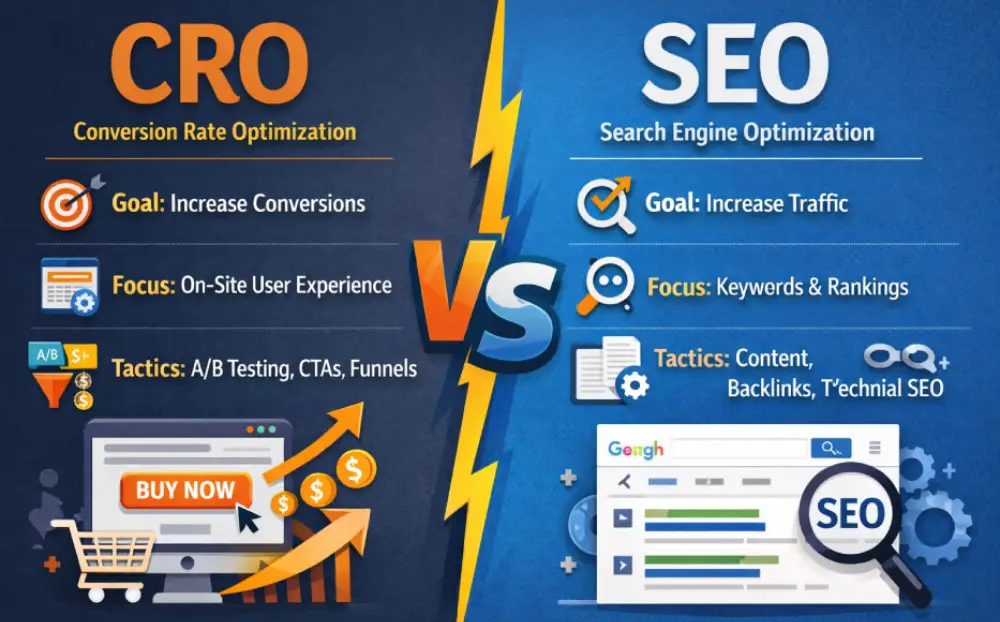
CRO doesn’t try to replace your traffic strategy. It works alongside it. If you’re currently converting 2% of your visitors and CRO helps you reach 4%, you’ve effectively doubled your revenue without spending an extra rupee on ads or SEO.What Does a Conversion Really Mean?
| Industry | Example Conversions |
| eCommerce | Product purchase, add to cart, email sign-up |
| SaaS/Tech | Free trial sign-up, demo request, subscription upgrade |
| B2B Services | Contact form submission, whitepaper download, discovery call booked |
| Healthcare | Appointment booking, patient registration, inquiry form |
| Education | Course enrollment, brochure request, webinar registration< |
| Real Estate | Property inquiry, site visit booking, mortgage calculator use |
| Local Business | Phone call, directions click, review, contact form |
PRO TIP
Understanding your most valuable conversion and the micro-steps that lead to it is the foundation of every effective CRO program. Before running a single test, map out your conversion path completely.
2. Why CRO Matters More Than Ever in 2026
The ROI Is Unmatched
Traffic Has a Cost; Conversions Have Value
Consumer Expectations Have Risen
AI Has Changed the Game
| Without CRO | With CRO |
| Traffic costs keep rising to maintain revenue | Revenue grows without proportional ad spend |
| No clear understanding of why users aren’t converting | Data-backed insights into friction points and drop-offs |
| Random design changes based on gut feel | Structured tests with measurable outcomes |
| Losing visitors to competitors with better UX | Building a digital experience that earns trust and drives action |
3. How to Calculate Your Conversion Rate
The formula is simple: Conversion Rate = (Number of Conversions ÷ Total Visitors) × 100
For example, if your landing page received 5,000 visitors last month and generated 175 purchases, your conversion rate is (175 ÷ 5,000) × 100 = 3.5%. But the conversion rate alone is only part of the story. Smart CRO practitioners also track conversion rate by traffic source, by device type, by landing page or funnel step, by audience segment, and over time to identify seasonal patterns. This segmentation reveals where the real opportunities are. A site-wide conversion rate of 2.5% might hide a mobile conversion rate of just 0.8%, pointing to a clear mobile UX problem.What Is a Good Conversion Rate?
| Industry | Average Conversion Rate | Top 10% Performers |
| eCommerce (overall) | 1.5%–3% | 5%+ |
| B2B Lead Generation | 2.5%–5% | 10%+ |
| SaaS Free Trial | 3%–7% | 12%+ |
| Email Sign-up | 1%–5% | 8%+ |
| Landing Pages (PPC) | 2%–5% | 11%+ |
| Healthcare/Finance | 1%–3% | 5%+ |
PRO TIP
Don’t benchmark against industry averages as a ceiling; treat them as a floor. Your real benchmark should be your own baseline, and the goal is to beat it consistently through testing and optimization.
4. The CRO Process: A Proven Framework
Step 1: Research & Discovery
Step 2: Hypothesis Formation
Step 3: Prioritization
Step 4: Test Design & Implementation
Step 5: Running the Test
Step 6: Analysis & Iteration
5. Core CRO Techniques That Actually Work
A/B Testing
Landing Page Optimization
Conversion Funnel Analysis
Website Personalization
Social Proof Optimization
Page Speed Optimization
Form Optimization
6. CRO Tools Every Marketer Needs
| Category | Best-in-Class Tools | What They Do |
| Analytics & Data | Google Analytics 4, Mixpanel | Track traffic, user behavior, funnels, and goal completions |
| A/B Testing | VWO, Optimizely, Convert | Run controlled experiments across page elements |
| Heatmaps & Recordings | Hotjar, Microsoft Clarity, FullStory | See exactly where users click, scroll, and drop off |
| User Research | Typeform, Maze, UserTesting | Gather qualitative insights from real users |
| Personalization | Dynamic Yield, Optimizely, Segment | Show tailored experiences based on user context |
| Page Speed | Google PageSpeed Insights, GTmetrix | Identify and fix speed issues affecting conversions |
PRO TIP
No tool will do the thinking for you. The value of CRO tools lies in the insights they surface, not the features they offer. A team that knows how to read a heatmap will always outperform one that just installs the software.
7. Common CRO Mistakes (and How to Avoid Them)
Mistake 1: Testing Without Enough Traffic
Mistake 2: Changing Too Many Things at Once
Mistake 3: Stopping Tests Too Early
Mistake 4: Ignoring Mobile Users
Mistake 5: Focusing Only on the Homepage
Mistake 6: Treating CRO as a One-Time Project
8. Industry-Specific CRO Benchmarks
eCommerce
B2B & SaaS
Healthcare & Financial Services
Local Services
9. How Monarch Web World Approaches CRO
We Start With Your Data, Not Assumptions
We Layer Quantitative Data With Qualitative Insight
We Build a Structured Testing Roadmap
We Connect CRO to Your Revenue, Not Vanity Metrics
PRO TIP
Don’t benchmark against industry averages as a ceiling; treat them as a floor. Your real benchmark should be your own baseline, and the goal is to beat it consistently through testing and optimization.
7. Common CRO Mistakes (and How to Avoid Them)
Mistake 1: Testing Without Enough Traffic
Mistake 2: Changing Too Many Things at Once
Mistake 3: Stopping Tests Too Early
Mistake 4: Ignoring Mobile Users
Mistake 5: Focusing Only on the Homepage
Mistake 6: Treating CRO as a One-Time Project
8. Industry-Specific CRO Benchmarks
eCommerce
B2B & SaaS
Healthcare & Financial Services
Local Services
9. How Monarch Web World Approaches CRO
We Start With Your Data, Not Assumptions
We Layer Quantitative Data With Qualitative Insight
We Build a Structured Testing Roadmap
We Connect CRO to Your Revenue, Not Vanity Metrics
OUR RESULTS
Monarch Web World has helped clients achieve 200%+ early growth rates and 90%+ improvements in ROAS through integrated CRO, SEO, and paid media strategies. Our CRO approach is built on data, tested with discipline, and measured by results that directly impact your bottom line.