
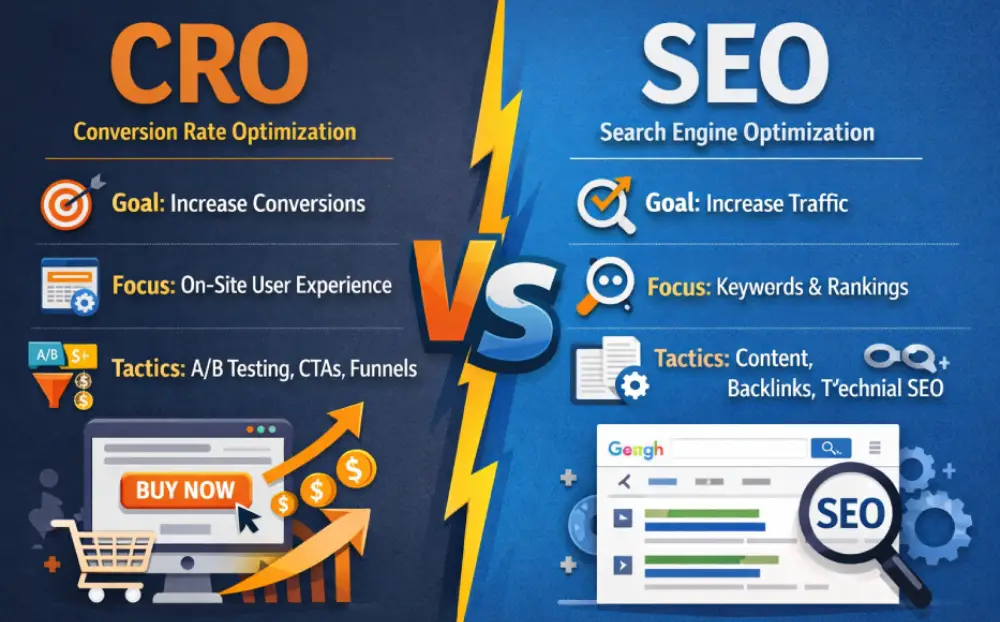
Which Should You Focus On, and Why the Answer Might Surprise You
This question comes up in almost every digital marketing conversation. You have limited time and resources. Should you focus on bringing more traffic to your site through SEO or on converting the traffic you already have through CRO?
The real answer is both. But understanding how they’re different, how they overlap, and how they amplify each other will help you decide where to direct your energy right now.
What SEO Does
What CRO Does
| SEO | CRO |
| Increases traffic volume | Increases value of existing traffic |
| Results typically take 6–12 months | Results can begin in weeks |
| Measured by rankings, organic traffic | Measured by conversion rate, revenue per visitor |
| Improves site structure, content, authority | Improves landing pages, UX, trust, messaging |
| Serves future visitors | Serves current visitors |
When They Overlap
CRO and SEO share important common ground. Page speed, mobile-friendliness, clear information hierarchy, structured content, and user experience all influence both search rankings and conversion rates. A page that’s optimized for conversions is often also better optimized for search and vice versa. This is not a coincidence. Both disciplines are ultimately trying to serve the user well.
Revenue growth possible by improving conversion rate from 1% to 2% without adding any new traffic
ROI multiple that CRO delivers vs. paid acquisition in mature programs
6–12
Months SEO typically takes to show significant traffic results
Which Should You Prioritize?
If you’re getting minimal organic traffic (fewer than a few thousand monthly visitors), SEO needs to come first. Without sufficient traffic, you can’t run reliable conversion tests, and the impact of CRO improvements will be limited in absolute terms.
If you have reasonable traffic but weak conversion rates, CRO delivers faster ROI. It’s easier and cheaper to double your conversion rate from 1% to 2% than to double your organic traffic.
The ideal is to run both in parallel, with CRO feeding insights to SEO (which pages drive the best quality traffic?) and SEO feeding volume to CRO (more traffic means faster, more reliable tests).
How the Two Disciplines Inform Each Other
| CRO Insight | SEO Application |
| High-converting landing page copy reveals the language your audience uses | Use that language in title tags, meta descriptions, and headers |
| The heatmap shows users repeatedly clicking an image that isn’t a link | Signals a content gap; create a linked resource page there |
| Visitors from organic search convert at half the rate of email traffic | Review landing pages for organic traffic; message-match improvements needed |
| Exit surveys reveal users want a pricing comparison tool | Publish a comparison guide; it’ll rank and convert |
PRO TIP
At Monarch Web World, we treat CRO and SEO as two sides of the same growth engine. Clients who invest in both simultaneously see compounding returns that neither discipline achieves alone. The fastest-growing websites in any category are usually exceptional at both.
The Compounding Case for Both
Here’s a scenario worth thinking through. You’re currently getting 10,000 organic visitors a month, converting at 2%, 200 customers. SEO doubles your traffic to 20,000 visitors. You now have 400 customers. Meanwhile, CRO doubles your conversion rate to 4%. Now those same 20,000 visitors produce 800 customers. The combination of both working together creates a result that’s 4x the starting point not 2x.
This compounding dynamic is why the CRO vs. SEO framing is ultimately the wrong question. The right question is, what’s the right investment ratio between them right now, given your traffic level and conversion rate?