
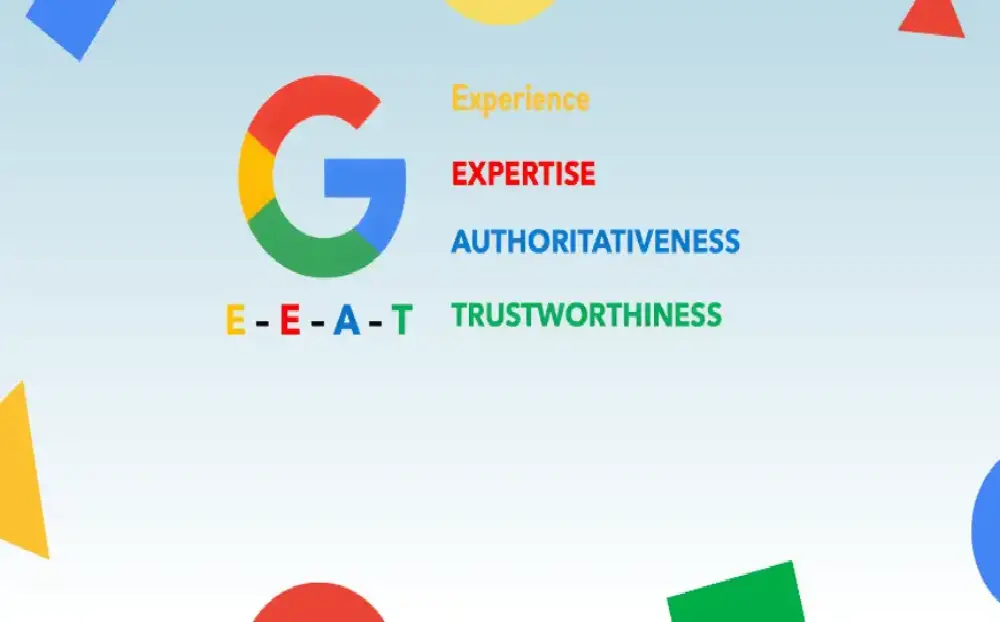
In 2022, Google updated its quality rater guidelines to add a fourth E to the E-A-T framework, making it E-E-A-T: Experience, Expertise, Authoritativeness, and Trustworthiness. At the time, most marketers treated it as a Google-specific concern, something to think about when optimizing for health, finance, or legal content.
That framing was too narrow. Today, E-E-A-T isn’t just a Google evaluation framework. It’s the closest thing we have to a universal standard for how AI systems decide which sources to trust, cite, and surface in their answers. And for most businesses, the honest self-assessment is that their E-E-A-T signals are weaker than they realize.Breaking Down What Each Letter Actually Means for AI
Experience: Have You Actually Done This?
The first E Experience is about demonstrating firsthand, personal experience with a topic. This was Google’s recognition that theoretical expertise isn’t the same as applied knowledge. A nutritionist who has counseled 500 patients has different credibility than a nutritionist who has only read the research.
For AI systems, experience signals show up in content that includes specific case studies, first-person application of principles, proprietary data from real client or customer work, and lessons learned from failure as well as success. The distinctive marker of experienced content is specificity, not “companies that do X tend to see Y results,” but “when we implemented X for a manufacturing client in the Midwest, here’s what actually happened.”Expertise: Do You Actually Know Your Subject?
Expertise is about demonstrated domain knowledge, the depth of understanding that separates a practitioner from a generalist. For AI systems evaluating expertise, the signals include accurate use of technical terminology, depth of coverage on complex subtopics, ability to address edge cases and nuances, and alignment with the established consensus of a professional community.
Content that glosses over complexity, avoids technical specifics, or relies heavily on surface-level generalizations scores poorly on expertise signals even if it’s well-written and clearly structured. AI systems are increasingly good at recognizing the difference between a genuine expert’s explanation and a well-organized summary of what experts generally say.Authoritativeness: Are Others Pointing to You?
Authoritativeness is about external validation. It’s not what you say about yourself; it’s what others say about you. This is where the overlap between traditional SEO and AI SEO is strongest: the same link-building and brand mention signals that establish authority in Google’s eyes contribute to the authority signals that AI training data encodes.
For AI citation purposes, authoritativeness is especially important in academic and research contexts. Content that is cited in other authoritative sources, referenced in industry publications, or linked from recognized institutional domains carries materially stronger authority signals than content that only appears on your own domain.Trustworthiness: Would a Careful Person Believe This?
Trustworthiness is the broadest and most foundational signal. It encompasses accuracy, transparency, intellectual honesty, and the structural markers that help readers evaluate credibility. For AI systems, trustworthiness signals include clearly attributed authorship with verifiable credentials, accurate citations to primary sources, transparent disclosure of limitations or uncertainty, and a track record of factual accuracy over time.
Content that makes overconfident claims, fails to cite sources for statistics, uses anonymous authorship, or has been found to contain factual errors is actively penalized in AI citation systems not by a rule, but by the statistical patterns in training data that associate these features with lower-quality sources.Of AI-generated search results, E-E-A-T is treated as a major ranking factor
More likely to be cited when content includes author credentials and experience signals
What Strong E-E-A-T Actually Looks Like in Practice
For most businesses, improving E-E-A-T is less about a single project and more about building consistent systems. Here’s what the highest-scoring organizations do differently:
- Real people with real credentials write and review content, and those credentials are visible and linked to verifiable professional profiles
- Original research, surveys, or proprietary data appears regularly in their published content, giving AI systems unique factual material to cite
- Third-party citations are current, primary-source links, not links to aggregators or secondary coverage
- Author bios are robust pages, not footnotes; they demonstrate both expertise and experience
- Content is updated when facts change, maintaining accuracy signals over time, not just at publication
- The brand is mentioned as an expert source in external publications through PR, contributed articles, industry speaking, and awards
The Anonymous Content Problem
One of the most common E-E-A-T weaknesses for businesses is anonymous content articles published under “Staff Writer” or the company name with no attributed human author. AI systems trained on quality signals have learned that anonymous content correlates with lower reliability. Attributing every published piece to a real person with visible credentials isn’t just about optics; it’s a direct signal to AI systems about the trustworthiness of your information.